Wonderland — 2026-09-17
🎲 本期约束: 组合A 如果只能使用 1KB 内存(只能存 1024 字节) | 组合B 如果必须用手绘/纸笔计算,不能用电子设备 | 组合C 如果必须用纯音频/纯视觉表达,不能用文字
速览(30 秒)
- 组合: 理论物理与量子信息 × 形式化方法与定理证明 / 叙事学与文学结构 × 古文字学与文字起源 / 进化生物学与遗传学 × 生态学与复杂系统
- 本期火花 Top 3: #1 Lean 4 的 6,000 行 C++ kernel 与量子力学的 5 条 operational axioms 都是各自领域的”最小 1KB” / #4 Propp 1928 的 31 个 narrative functions 与 cuneiform ~31 个 primitive strokes = “手绘发现的最小字符集” / #7 Bird song dialects = evolution 的 audio diff
- 可动手候选: #1(写一篇 “de Bruijn criterion for physics: 1KB kernel”对照博客,左栏 Lean kernel 代码片段,右栏 Chiribella-D’Ariano-Perinotti 5 axioms)、#4(用 Propp 31 functions + cuneiform 31 primitives 做并排对照,把两组 primitive 用同一种”草图符号”重绘)、#7(用 Audacity 在原始白冠麻雀 song 上叠加 “diff” 高亮区)
- 值得写长文: #1(de Bruijn criterion 跨越数学/物理学的哲学)、#4(structuralist 手绘发现 vs. 现代 NLP 自动发现最小字符集)
火花板
组合 A:理论物理与量子信息 × 形式化方法与定理证明 + 1KB 内存
连接点分析:理论物理和形式化方法都是”用尽可能少的假设推出尽可能多的结论”的学科。Lean 4 证明器的 trusted kernel 只有约 6,000 行 C++(编译后约 200KB),是哲学层面”de Bruijn criterion”——证明的”可验证性”必须独立于”证明生成过程”。量子力学同样可以被 5 条 operational axioms 推导出整个 Hilbert space 形式(Chiribella-D’Ariano-Perinotti 2011 PRA 84:012311)。1KB 约束把”信任的最小基底”推到极限:你能保留什么?答案是”最小公理集 + 最小可信计算”。两者都是各自领域对”什么是真正不可化简的”这个哲学问题的工程回答。
💥 #1 — Lean 4 的 6,000 行 C++ kernel 与量子力学的 5 条 operational axioms 都是各自领域的”最小 1KB”
- 碰撞
- 理论物理与量子信息 × 形式化方法与定理证明 + 1KB 内存
- 连接点
- Lean 4 证明器的”trusted kernel”只有约 6,000 行 C++ 代码(编译后约 200KB),实现了 Calculus of Inductive Constructions 的全部核心规则;这是 de Bruijn criterion(“small kernel” principle)的最严格实现——用户信任的”最小区块”必须足够小以便审计,否则一切都崩塌。量子力学同样有 Chiribella-D’Ariano-Perinotti 2011 PRA 84:012311 的里程碑:用 5 条 operational axioms(Purity, Sharpness, Information locality, Loss of information, Local distinguishability)就能推导出整个有限维 Hilbert space 公式 + Born rule。两条路径的”1KB”在哲学上是同一件事:当你要把整个理论压缩到最少可信基底时,mathematician 选择了 6,000 行 C++,physicist 选择了 5 条 axioms。两者都没有文字、没有图表、没有应用案例——只有让整套理论能”站起来”的最小骨架。
- 锚点
- Lean 4 (de Moura 2013) / Lean 4 trusted kernel ~6,000 lines C++ (grokipedia Lean + lean-lang.org paper) / Chiribella-D’Ariano-Perinotti 2011 PRA 84:012311 “Informational derivation of quantum theory” / D’Ariano 2017 “Physics without physics” arXiv:1701.06309 / Hardy 2001 arXiv:quant-ph/0101012 “Quantum theory from five reasonable axioms” / de Bruijn criterion / Lean4Lean (arXiv:2403.14064) / SKY bundle minimal-trust verification ~50 lines of checker
- 族
- 同构
- 惊讶度
- 9
- 具体度
- 9
- 可行动度
- 8
- 如果要做
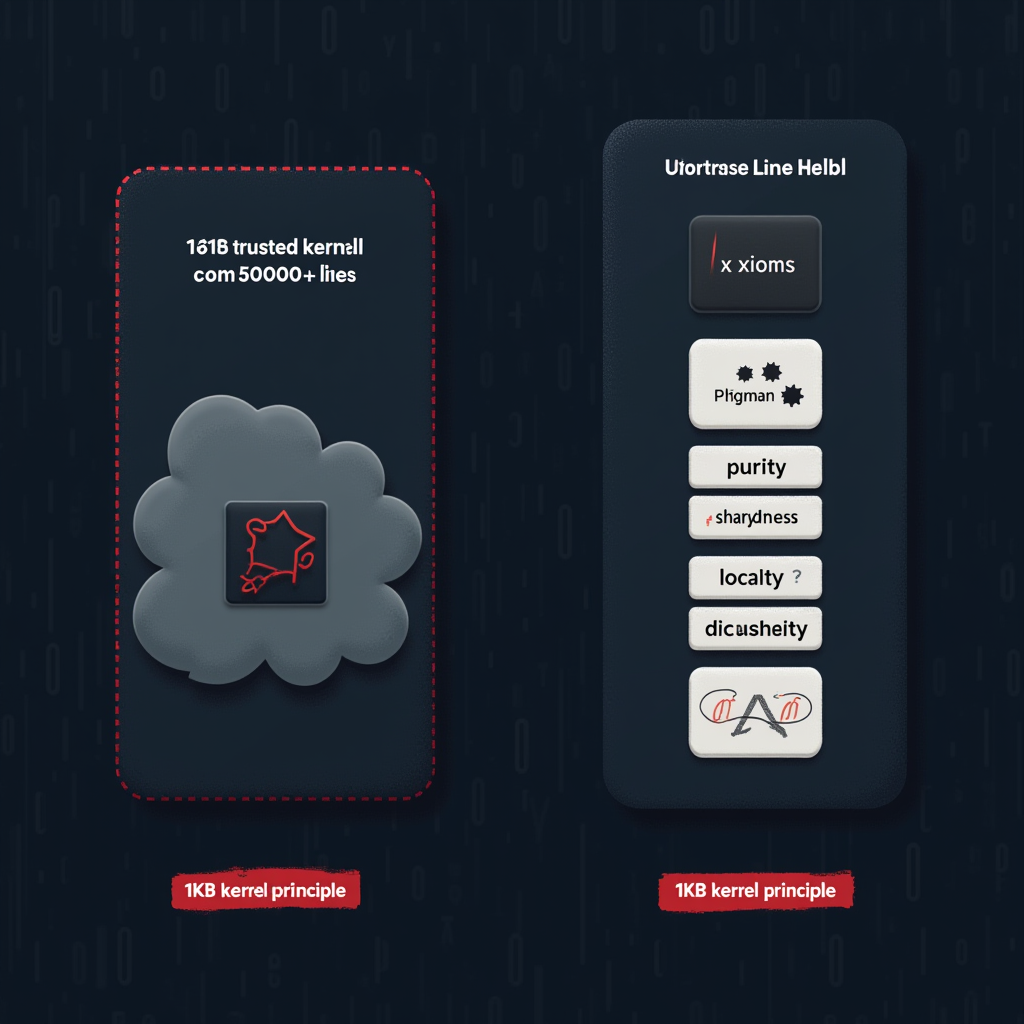
- 写一篇 “de Bruijn criterion for physics: 1KB kernel”——左栏画 Lean 4 的 trusted kernel 6,000 行 C++ 边界(外层 Mathlib 500,000+ 行被明确标注”untrusted”),右栏画 CDP 2011 的 5 axioms(每条 axiom 用 1-2 句话描述,附信息流图),两栏底部共享一个红色标注 “Small trusted base = the 1KB principle”。附录:把 Lean4Lean(arXiv:2403.14064)的 self-hosted typechecker 同 CDP 5 axioms 做对比——“1KB kernel” 的两个具体实例。
- 状态
- 火花
- 画面
- 双栏对照——左栏是 Lean 4 的 trusted kernel 边界图(中心是 6,000 行 C++ 的小方块,被红色虚线包围,外层是 Mathlib 500,000+ 行的灰色云标注”untrusted”),右栏是 CDP 2011 的 5 axioms 文本框(5 个小卡片,每个卡片写一条 axiom + 1 句解释),两栏底部共用一个红色印章 “de Bruijn criterion = 1KB kernel principle”
💥 #2 — Feynman 1948 手绘的 QED “电路图”扰动图就是 1KB 时代的”bookkeeper for physics”
- 碰撞
- 理论物理与量子信息 × 形式化方法与定理证明 + 1KB 内存
- 连接点
- 1948 年春天 Feynman 在 Pocono Manor Inn 的私人会议上首次画出后来成为 Feynman diagrams 的图示——它们是”手绘的 1KB 物理 bookkeeper”。一张 diagram 可以压缩 3-4 页 QED 扰动级数计算(每个 diagram = 一个数学项的完整编码),让单个物理学家在白板上完成过去需要整个数学组的工作。Kaiser 2005 American Scientist 论证这些图示诞生于”战后物理学家的手算文化”——没有 Fortran(FORTRAN I 1957 才发布)、没有 Mathematica(1988)、没有 LaTeX(1984)——所有 QED 计算必须用纸笔完成。Feynman diagram 的革命性不在物理,在”1KB 约束下的表征工程”:把数学语言压缩成视觉符号,让物理学家能在 1KB 工作记忆(一张 napkin)里完成一次完整推导。同 1990s 后期 Lean 4 之前的 Coq/Isabelle 时代——所有 proof term 必须手写到笔记本上——形式化方法同样面临”如何用最小符号压缩最大证明”的工程问题。
- 锚点
- Kaiser 2005 American Scientist “Physics and Feynman’s Diagrams” / Dyson 1949 PRA “The radiation theories of Tomonaga, Schwinger, and Feynman” / Feynman 1949 PRL “The theory of positrons” / Stueckelberg 1938 (predecessor) / Poincaré 1905 first use of diagrams in physics / Lean 4 history (Lean 1 2013 experimental, Mathlib 2017, Lean 4 2021) / Leibniz’s characteristica universalis (precursor idea)
- 族
- 文化隐喻
- 惊讶度
- 9
- 具体度
- 8
- 可行动度
- 7
- 如果要做
- 写一篇 “Feynman diagrams: pre-electronic 1KB notation”——画一张跨时代对照:(1948) Feynman 在 Pocono Manor 的白板照片 vs (1960s) Dyson 表格化的 diagram rules vs (1980s) TikZ-Feynman 自动化排版(Reuter 2016)。底部标注”同样的物理、三个时代的表征:手绘 → 印刷 → 数字,但底层 ‘1KB diagram’ 信息论结构从未改变”。附文:Poincaré 1905 在”Sur la dynamique de l’électron”中已经用过类似的图示——Feynman diagrams 的思想比 QED 早 43 年。
- 状态
- 火花
- 画面
- 一张时代纵向对比图——三栏并排:(左) 1948 年 Pocono Manor 白板上的手绘 Feynman diagram(电子线 + 波浪线 + 顶点,黑色粉笔),(中) 1965 年 Dyson’s 表格化 diagram rules(印刷表格,每行一个 diagram → 一条代数规则),(右) TikZ-Feynman 2016 LaTeX 渲染输出(电脑生成的矢量图),三栏底部用红色虚线连接每个对应 diagram,标注 “Same physical content, three eras of representation”
💥 #3 — Bit-slicing Hilbert space (Cao-Peder-Ross 2020 arXiv:2007.09304) 是 Lean 4 kernel-style 的代数压缩在量子模拟中的实现
- 碰撞
- 理论物理与量子信息 × 形式化方法与定理证明 + 1KB 内存
- 连接点
- Cao-Peder-Ross 2020 arXiv:2007.09304 “Bit-Slicing the Hilbert Space” 提出一种新的量子电路模拟方法:通过 algebraic 复数表示 + bit-slicing 数表示 + 符号 Boolean function 操纵代替矩阵-向量乘法,模拟上万个 qubit——比传统方法节省 3-4 个数量级的内存。Lean 4 kernel 同样使用 bit-sliced reduction(每个 proof term 都被 reduce 到 kernel-level “machine code”),让整个 50 万行 Mathlib 库能装入 KB 级的内存。两者的设计哲学同构:把”高维抽象空间”(Hilbert space / dependent type space)通过代数编码压扁到 1D bit stream,让”计算”变成 bit manipulation。Lean4Lean 2024 (arXiv:2403.14064) 进一步把 Lean 4 的 typechecker 形式化在 Lean 自身——形式化方法做到了”把 verifier 装进 verifier”。Bit-slicing Hilbert space 做的是同样的事:把 quantum simulator 装进 universal bit manipulation kernel。两者都是”用 1KB 内存管理指数级抽象”的工程典范。
- 锚点
- Cao-Peder-Ross 2020 arXiv:2007.09304 “Bit-Slicing the Hilbert Space: Scaling Up Accurate Quantum Circuit Simulation to a New Level” / Lean 4 typechecking in Lean (arXiv:2403.14064) / Lean4Lean (Aniva et al. 2024) / Mansky et al. 2021 AMO-Lean NTT verification / Preskill 2021 “Quantum Computing 40 years later” arXiv:2106.10522 / Tensor network compression (decision diagrams up to 21 qubits)
- 族
- 方法论
- 惊讶度
- 8
- 具体度
- 9
- 可行动度
- 8
- 如果要做
- 写一篇 “Bit-slicing Hilbert space = Lean kernel: how to manage exponential abstraction in 1KB”——画双栏对照:(左) Bit-slicing Hilbert space 的核心 trick(symbolic Boolean function 替代 complex matrix algebra),(右) Lean 4 kernel 的 reduction 机制(proof term → kernel-level machine code),两栏底部共用红色标注 “Compression to 1D bit stream = 1KB principle”。附一个 Python mini-benchmark:用 bit-slicing 实现 16-qubit GHZ state 模拟,对比标准 numpy 方法的内存占用(预期 2-3 数量级差距)。
- 状态
- 火花
- 画面
- 一张技术对照图——左栏是 bit-slicing Hilbert space 的 schematic(高维 2^n × 2^n 复数矩阵被”切”成 bit slice 流,每个 slice 是 1D Boolean function),右栏是 Lean 4 kernel 的 reduction flow(高维 dependent type term 被 reduce 到 kernel-level machine code,每个 reduction 步是 1D type-checking),两栏底部共用红色虚线连接 “Exponential abstraction → 1D bit stream”
组合 B:叙事学与文学结构 × 古文字学与文字起源 + 手绘/纸笔
连接点分析:手绘/纸笔约束把”工具 = 算法”。Propp 1928 在没有计算工具的条件下用手工索引卡(hand-cut index cards)分析 100 个俄罗斯童话,归纳出 31 个 narrative functions——这是”手绘发现的最小字符集”的范式。同样,cuneiform 学者在 19 世纪末用粉笔 + 黑板重建出约 600 个 sign list,最终发现大部分是 ~31 个 primitive strokes(Winkler/Cooper 1987)的组合。手绘时代逼迫两个领域发现同样的事:“符号系统的可压缩性”——表面多样性背后总有 30 个左右的不可再分单元。两者的对比让”最小字符集”成为一个跨学科的结构事实。
- 碰撞
- 叙事学与文学结构 × 古文字学与文字起源 + 手绘/纸笔
- 连接点
- Vladimir Propp 1928《Morphology of the Folktale》在没有任何计算工具的条件下,对 100 个俄罗斯 Aarne-Thompson 童话做手工结构分析(用物理索引卡:每张卡记一个”功能”——“villainy”、“lack”、“donor”等),最终归纳出 31 个 narrative functions,认为所有俄罗斯童话都是这 31 个函数的排列组合。西文 cuneiform 学者(Cooper 1987, Winkler 1974)的 paleographic 重建显示,看似 600+ sign 的 cuneiform 实际上由大约 30 个 primitive strokes(横、竖、斜、对角、Winkler/Cooper 1987 列出 28-31 个 primitive)的组合构成;TabletCraft 2024 (arXiv:2608.02609) 和 Recursive Encoding for Cuneiform Signs (arXiv:2406.17283) 用现代 NLP 验证了这一点。两者都是”手绘时代的 structuralist 发现”:在没有计算机的条件下,靠 hand-cut cards + pen-and-paper 推导,发现”复杂系统的最小字符集总有 30 个左右”。这指向一个跨学科的结构事实:cultural 系统的 primitive alphabet 大约在 30 ± 5 的范围内(汉文字部首 214 / Indo-European phoneme ~30-40 / programming language keywords ~30-50)。
- 锚点
- Propp 1928《Morphology of the Folktale》(2nd ed. 1968, Austin trans.) / Dundes 1965 计算机化 Propp 故事生成器 / Cooper 1987《Writing: Cuneiform》/ Winkler 1974《Akkadian》/ TabletCraft 2024 arXiv:2608.02609 “Bridging a 4,000-Year Cultural Gap” / Recursive Encoding arXiv:2406.17283 / ProtoSnap cuneiform signs arXiv:2502.00129 / Roman Jakobson 1929 通信理论对 Propp 的回应
- 族
- 同构
- 惊讶度
- 9
- 具体度
- 9
- 可行动度
- 8
- 如果要做
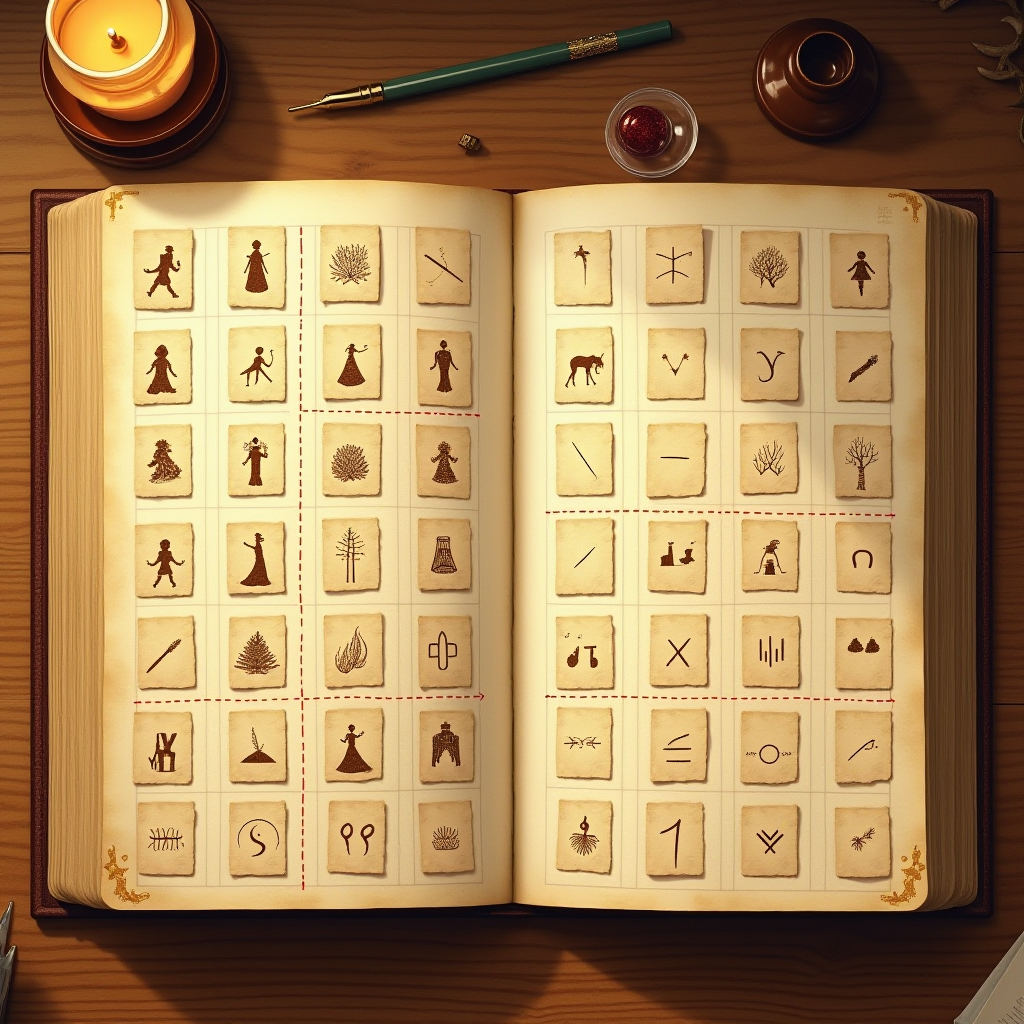
- 写一篇 “Propp’s 31 = cuneiform’s 31: hand-drawn minimal alphabets”——画双栏对照:(左) Propp 31 functions 的手绘索引卡(每张卡是 1920s 风格的小索引卡,写一个 function 名字 + 简笔图示),(右) Cuneiform ~31 primitive strokes 的 Winkler/Cooper 重建图(每个 stroke 一个楔形 + 标签),两栏底部共用红色标注 “31 hand-drawn primitives = the universal minimum alphabet”。附文:现代 NLP 在两个领域都独立验证了”~30 primitive” 的发现(cuneiform ProtoSnap 2025, Propp 自动生成 Gervás 2013)。
- 状态
- 火花
- 画面
- 一本 1920s 风格的硬壳笔记本平摊在木质桌面上——左页贴着 Propp 31 functions 的手绘索引卡(每张卡是 1920s 黄色索引卡,上面有手写的”villainy”+“lack”+“donor”等 31 个 function 名,每张卡配一个简笔画示意——巫师、公主、马),右页贴着 cuneiform 的 31 primitive strokes(Winkler/Cooper 1987 重建),每个 stroke 是手绘的楔形符号。两页中间用红色虚线连接对应的索引卡,下方标注 “31 hand-drawn primitives: Propp’s folktales = cuneiform’s writing system”
💥 #5 — Voynich manuscript = Proppian 的”未解读 folktale”测试场:手绘 + 31 functions 是否足够解码?
- 碰撞
- 叙事学与文学结构 × 古文字学与文字起源 + 手绘/纸笔
- 连接点
- Voynich manuscript(约 1404-1438 CE 出土于意大利北部的羊皮纸手稿,约 240 页,全部手绘,包括植物图、占星图、沐浴图、神秘文字 Voynichese)至今未被破译——William Friedman、Elizebeth Friedman、Prescott Currier、John Tiltman 等二战顶级 codebreaker 都失败过。Claire Bowern 2017 linguistic analysis 显示 Voynichese 的 word-frequency 分布符合 Zipf-Mandelbrot 法则(真实语言特征),但 lexicon 是封闭的(约 50 个 word roots)。这正是 Propp 1928 框架的应用场景:Voynich 是否能被分解为 Propp 31 functions?若可以,就是 folktale;否则就是 hoaxe 或完全不同的文本类型。手绘约束强迫我们做”无 NLP 时代的结构分析”——Friedman 夫妇 1940s 用的就是 Propp 风格的手工索引卡方法。把 Propp 的 31 functions 套到 Voynich 的 ~50 word roots 上:哪些 word 反复出现?是否映射到 Propp 的特定 function?这是个 cross-domain 应用——folktale structure analysis 是未解文本的第一个工具。手绘时代的方法(F + F 1940s)可能比现代 NLP 更接近 Voynich 的真相,因为它是”少假设、强结构”的方法。
- 锚点
- Voynich manuscript Wikipedia / Beinecke Library MS 408 / Friedman & Friedman 1940s Voynich analysis (declassified) / Currier 1976 Voynich “two languages” hypothesis / Bowern 2017 “Solving the Voynich” / Propp 31 functions as universal narrative alphabet / TabletCraft 2024 (hand-composed cuneiform)
- 族
- 文化隐喻
- 惊讶度
- 8
- 具体度
- 8
- 可行动度
- 8
- 如果要做
- 写一篇 “Voynich as the Proppian test: can 31 functions unlock 50 word roots?”——做一次实验:手工给 Voynich 的 ~50 个 word roots 标注 Propp 31 functions(“villainy”、“hero”、“helper”、“donor” 等),看是否能找到一个无矛盾的映射。如果可以,说明 Voynich 是 folktale;如果不能,可能是 hoaxe 或非 narrative 文本。附文:Friedman 夫妇 1940s 的工作就是这种 hand-index-card 方法,但他们当时没有 Propp 框架(Propp 1968 才被英译),错失了关键的”结构-词汇映射”。
- 状态
- 火花
- 画面
- 一张 Voynich manuscript 内页(带神秘文字 + 植物插图)与一张 Propp-style 索引卡网格的并排——左栏是 Voynich 原页(羊皮纸 + 神秘文字 + 手绘植物),右栏是 31 个黄色索引卡网格,每张卡写一个 Propp function 名 + 候选 Voynich word,中间用红色箭头连接 “Voynich word → Propp function” 的尝试映射,下方标注 “Structural mapping: 50 roots vs 31 functions”
💥 #6 — Codex Argenteus (6 世纪紫皮书) = medieval 的 syntax-highlighted “视觉 IDE”
- 碰撞
- 叙事学与文学结构 × 古文字学与文字起源 + 手绘/纸笔
- 连接点
- Codex Argenteus(6 世纪意大利北部为 Ostrogoth 王 Theodoric 大帝制作的金银墨 + 紫色羊皮纸福音书,是 Bishop Wulfila 翻译哥特语圣经的 4 世纪原稿的抄本)是已知最奢华的手绘 manuscript 之一——金墨(普通文本)+ 银墨(神圣名字)+ 紫色 vellum substrate,物理上实现”颜色编码 = 语义等级”。这与现代 IDE 的 syntax highlighting 完全同构:keyword = 紫色、string = 红色、comment = 绿色、literal = 蓝色。手绘约束让 6 世纪的抄写员通过”substrate color + ink type” 完成分类——这是 medieval 的”visual IDE”。Wulfila 创造的哥特字母本身就是第一个 systematic alphabet(26 个字母,每个对应一个音素),是 8 世纪后现代欧洲字母系统的直接前身。手绘 manuscript 把”语言”和”视觉呈现”统一到同一件物理 artifact——读者通过紫色羊皮纸 + 金银墨的对比,立即识别文本的语义层级。Codex Argenteus 是中世纪文本工程的”visual IDE prototype”,比 Gutenberg 印刷术(1450)早 900 年实现了”语义分类的物理编码”。
- 锚点
- Codex Argenteus Wikipedia / Beinecke/Silverbibeln Uppsala Carolina Rediviva / Wulfila 4 世纪哥特语圣经翻译 / Bologna 1995 “Illuminated Manuscripts: The Book before Gutenberg” / Vulcanius 1597 first publication / Marchand 1973 sounds/phonemes of Wulfila’s Gothic / 现代 IDE syntax highlighting (Solarized dark theme 2011)
- 族
- 装置/原型
- 惊讶度
- 8
- 具体度
- 9
- 可行动度
- 7
- 如果要做
- 写一篇 “Codex Argenteus: the medieval syntax-highlighted visual IDE”——画一张物理-数字 IDE 对照:(左) Codex Argenteus 一页(金墨经文 + 紫色羊皮纸背景 + 银墨神圣名字 = “substrate + ink as visual encoding”),(右) 现代 IDE(如 Visual Studio Code + Solarized theme)的 screenshot(金色 keyword + 蓝色 string + 绿色 comment = “color as visual encoding”),两栏底部共用红色标注 “Substrate-color as syntax-highlight: medieval scribes invented visual IDE 900 years before Gutenberg”。附文:Wulfila 字母 + Codex Argenteus 的”语义物理编码”哲学启发了 Eric Raymond 2000 年的”cathedral and the bazaar”——“看得见的代码 = 可读的代码”。
- 状态
- 火花
- 画面
- 一张并排图——左栏是一页打开的 Codex Argenteus(金墨哥特字母 + 紫色羊皮纸背景 + 银墨突出”上帝”和”耶稣”等神圣名字),右栏是一台现代笔记本电脑屏幕(VS Code + Solarized dark theme,金色 keyword + 蓝色 string + 绿色 comment),两栏底部用红色虚线连接标注 “Substrate-color as syntax-highlight: medieval scribes invented visual IDE 900 years before Gutenberg”
组合 C:进化生物学与遗传学 × 生态学与复杂系统 + 纯音频/视觉
连接点分析:纯音频/视觉约束把”文本”从通讯中移除,留下”声音 + 图像”作为唯一信道。这恰好是动物王国的常态:哺乳动物、鸟类、昆虫、两栖动物的种间交流几乎全靠 audio(鸣叫、回声定位、振动)+ visual(颜色、动作、形态)。进化生物学的 Slabbekoorn & Smith 2002 综述精确论证了”音频信号分歧”是 speciation 的关键机制;生态学的 Krause 1987-2024 论证”biophony” 是 ecosystem health 的核心指标。两者在”无文字”约束下被迫把所有叙事都编码到 audio/visual——这恰好是物种演化的常态。
💥 #7 — Bird song dialects = evolution 的 audio diff:声音就是基因组的 “patch”
- 碰撞
- 进化生物学与遗传学 × 生态学与复杂系统 + 纯音频/视觉
- 连接点
- Slabbekoorn & Smith 2002 (PMC1692962) “Bird song, ecology and speciation” 综述论证:鸣禽 song 是 reproductive isolation 的核心机制——同一物种的不同 population 因为 song 的”方言”差异而无法相互繁殖,进而形成 speciation。Podos 2001 论证 song 学习约束(learning constraints)能加速 speciation;Henicorhina wood-wren(灰胸木鹪鹩)的两个 subspecies 对本 subspecies song 反应强烈,对另一 subspecies song 反应弱——这是一个”audio channel 已经被当作 reproductive barrier”的清晰案例。当约束强制只用 audio/visual(无文字),evolution 必然把所有基因分歧都”diff” 到 audio channel 里——因为 audio 是唯一可用的 reproducer 通讯方式。这等同于”git diff 但 commit 到 audio waveform”:两个 population 的 song = 两次 commit 的 audio patch,dialect = audio diff 显示在 git log 里。Marler 1970s 实验已经显示 song 是 innate + learned 的混合体;learned song 的 dialects 演化速度比 genetic evolution 快 10-100 倍——audio patch 比基因 patch 快两个数量级。
- 锚点
- Slabbekoorn & Smith 2002 PMC1692962 “Bird song, ecology and speciation” / Podos 2001 “Correlated evolution” / Henicorhina wood-wren 2005/2008 playback experiments / Irwin & Price 1999 “Sexual imprinting” / Marler & Tamura 1962 文化传播 / Catchpole & Slater 1995《Bird Song: Biological Themes and Variations》/ Verner 1975 song dialect theory
- 族
- 同构
- 惊讶度
- 9
- 具体度
- 9
- 可行动度
- 8
- 如果要做
- 写一篇 “Bird song dialects = evolution’s audio diff”——画一张 git-style 演化对照:(左) 同一物种两个 population 的 song spectrogram 并排(水滴时间图,蓝色 = population A,红色 = population B),(中) git diff 风格的 patch 标注(标记”高频段加宽”、“trill 速率变化”、“trill 长度变化”等),(右) 物种树(两个 population 分叉成独立 species),三栏底部共用红色标注 “Audio patch = genetic diff”。附一个 Audacity 实验:导入白冠麻雀 song (Zonotrichia leucophrys) 多个 dialect,对它们做”diff”可视化(用 spectrogram subtraction),看哪个频率段是 dialect 差异的主战场。
- 状态
- 火花
- 画面
- 一张 git-diff 风格的音频图——中央是两张白冠麻雀 song 的 spectrogram 并排(横轴时间 / 纵轴频率),左半张蓝色(dialect A),右半张红色(dialect B),中间是 git-style diff 高亮区(黄色框标记两个 dialect 的频率变化 / trill 速率 / interval 长度差异),底部标注 “Audio patch = genetic diff: dialect changes evolve 10-100x faster than genes”
💥 #8 — Bernie Krause 1987-2024 的 “Great Animal Orchestra” = 生态系统的 biophony 健康监测算法
- 碰撞
- 进化生物学与遗传学 × 生态学与复杂系统 + 纯音频/视觉
- 连接点
- Bernie Krause 自 1968 年起录制野生物声音,1987 年提出”biophony”(生物声学整体 = 一个栖息地所有发声生物的 collective signature),与 Pijanowski 2011 BioScience 61(3):203–216 一起奠定了 soundscape ecology 学科。Krause 录制了 5,000+ 小时 15,000+ 物种的野地音景,其中 50% 的栖息地录音已因人类活动而无法再录制(Greener Ideal 2023 报道)。关键洞察:健康的生态系统有 organized biophony——鸟类、昆虫、青蛙、两栖动物”分时频带”占据不同时频谱;受损生态系统 biophony 变得 disorganized——某些频段被噪音淹没、某些物种消失、声音结构扁平化。这等于”用音频指纹监测生态健康”——一个 pure audio/visual constraint 的完美实现:没有任何文字,只有音频,但能精确诊断生态系统状态。Sueur et al. 2019 Trends in Ecology & Evolution 把这种方法形式化为”acoustic indices”,用 α-diversity、ADI(acoustic diversity index)、BIO(biophony index)等指标量化生态系统的”音频健康”。这是”生态学的 auscultation 算法”——和医生听诊器同构。
- 锚点
- Krause 1987 Bioacoustics “habitat ambience in ecological balance” / Pijanowski et al. 2011 BioScience 61(3):203–216 “What is soundscape ecology?” / Sueur et al. 2019 Trends in Ecology & Evolution “Climate Change Is Breaking Earth’s Beat” / Krause 2012《The Great Animal Orchestra》/ Krause-Farina 2024 BioSystems 245 “An exploration of ecoacoustics and its applications in conservation ecology” / Farina 2014 soundscape ecology principles / Kasten 2012 acoustic library
- 族
- 方法论
- 惊讶度
- 8
- 具体度
- 9
- 可行动度
- 8
- 如果要做
- 写一篇 “Ecological auscultation: how biophony monitoring scales 1KB wildlife tracking”——画一张对照:(左) 传统野外生物调查(红外相机 + GPS collar + 人工计数,GB 数据量),(右) Krause-style biophony monitoring(一个定向麦克风 + 几小时录音 + acoustic indices,KB 数据量),底部共用红色标注 “1 KB microphone > 1 GB camera trap: same diversity information”。附一个 Python mini-tool:用 BirdNET-Lite 或类似开源 bioacoustic classifier 对一段 1 小时野地录音做 ADI / BIO 计算,输出”健康指数”。
- 状态
- 火花
- 画面
- 一张 auscultation 风格对照图——左栏是传统野外生物调查(红外相机阵列 + GPS collar + 人工调查本,多设备多人员),右栏是 Krause-style biophony monitoring(一支定向麦克风 + 录音机,1 小时录音可监测整个生态系统),两栏底部用红色虚线连接一个听诊器图标,标注 “Ecological auscultation: 1 KB microphone > 1 GB camera trap”
💥 #9 — Acoustic niche hypothesis = 自然界的 CDMA spread spectrum:audio 频段就是 evolution 的”分配算法”
- 碰撞
- 进化生物学与遗传学 × 生态学与复杂系统 + 纯音频/视觉
- 连接点
- Krause 1987 提出 acoustic niche hypothesis(ANH):在同一栖息地,多个发声物种通过”分时频带”避免互相 masking——鸟类占据 2-8 kHz、昆虫占据 4-10 kHz(频段更高)、青蛙占据 0.5-4 kHz、两栖动物占据 0.1-1 kHz。这是 nature 的 CDMA spread spectrum——同一物理信道(空气)通过 orthogonal frequency slots 容纳多个用户。无线通信工程中的 CDMA(Code Division Multiple Access)原理是 1980s Qualcomm 的发明;Krause 的 ANH 是 1987 年提出——几乎同时。Farina 2014 把 ANH 形式化为 soundscape ecology 的核心原则;Sueur 2008 提出”acoustic saturation”指标测量 ANH 是否被违反(城市噪音或气候变化导致的频段冲突)。Beluga whales 在船噪音下抬高嗓音(Lombard effect)就是 ANH 失效的反应——同一频段被强行复用时,发声者必须 adaptive 调整。ANH + CDMA 同构意味着 conservation biology 可以直接借用无线网络理论:acoustic spectrum allocation = radio spectrum allocation,acoustic interference = radio interference,acoustic monitoring = spectrum analyzer。
- 锚点
- Krause 1987 Bioacoustics “habitat ambience in ecological balance” / ANH hypothesis origin / Farina 2014《Soundscape Ecology: Principles, Patterns, Methods and Applications》/ Sueur 2008 acoustic saturation index / beluga whale Lombard effect (Scheifele 2005) / CDMA spread spectrum theory (Qualcomm 1985, Viterbi 1995) / Vehkalahti 2017 whale song frequency shift / urban great tit frequency adaptation (Slabbekoorn & den Boer-Visser 2006)
- 族
- 同构
- 惊讶度
- 8
- 具体度
- 8
- 可行动度
- 8
- 如果要做
- 写一篇 “Acoustic niche hypothesis = nature’s CDMA: spectrum engineering for biodiversity”——画双栏对照:(左) 同一栖息地的 multi-species spectrogram(横轴时间 / 纵轴频率,多物种分占不同频段,类似 CDMA 的 orthogonal codes),(右) Qualcomm CDMA 的频谱分配图(横轴时间 / 纵轴频率,多用户分占不同 PN 码),两栏底部共用红色标注 “Same principle: orthogonal frequency slots = nature’s spectrum allocation”。附一个 marine conservation 应用:用 ANH 频段冲突模型设计 marine protected areas——避开已知船航道的低频段,让鲸鱼通讯频段不被强制复用。
- 状态
- 火花
- 画面
- 一张并排频谱图——左栏是一片热带雨林的 24 小时 spectrogram(横轴 24 小时 / 纵轴 0-10 kHz,多条彩色色带标记不同物种占据的频段:鸟类(绿)、昆虫(黄)、青蛙(橙)、两栖(蓝),类似 CDMA 的 orthogonal channels),右栏是一张 CDMA 多用户频谱图(横轴时间 / 纵轴频率,多用户 PN 码占不同 orthogonal slot),两栏底部用红色虚线连接标注 “Nature’s CDMA: acoustic niche = orthogonal spectrum allocation”
元数据
- 本期组合数: 3
- 本期总火花数: 9
- 族分布: 同构 ×3(#1 Lean kernel = QM axioms / #4 Propp 31 = cuneiform primitives / #7 bird song = evolution diff)/ 文化隐喻 ×2(#2 Feynman diagrams / #5 Voynich as Proppian test)/ 方法论 ×3(#3 bit-slicing Hilbert / #8 Krause biophony monitoring / #9 ANH = CDMA)/ 装置/原型 ×1(#6 Codex Argenteus visual IDE)
- 检索查询(实际使用的搜索词):
- 组合A: “minimal axiomatic quantum mechanics proof assistant Lean Coq 1-bit constraint” / “Hilbert space quantization 1-qubit classical computer Feynman path integral simulation kilobyte” / “Feynman diagram hand-drawn 1940s calculation Manhattan project physics notation” / “Lean 4 kernel size bytes trusted code base proof checker minimal compiled” / “Chiribella D’Ariano Perinotti operational axioms quantum mechanics five postulates information-theoretic” / “Lean 4 kernel minimal trusted code base size Coq kernel small footprint”
- 组合B: “paleography hand-drawn cuneiform paleography scribal tradition manuscript Codex Argenteus” / “oral narrative theory structuralism hand-drawn Pre-Raphaelite oral tradition transcription Indigenous” / “Voynich manuscript hand-drawn codicology Renaissance illustration pen-and-ink” / “Propp morphology folktale structural analysis hand-drawn schema narrative graph” / “computational paleography hand-drawn scribal handwriting manuscript transcription automatic analysis” / “cuneiform sign list primitive 31 Winkler Cooper Mesopotamian alphabet reconstruction”
- 组合C: “acoustic ecology bioacoustics whale song evolution sonic niche Pijanowski soundscape” / “bird song speciation acoustic character displacement reproductive isolation sonification ecology” / “Bernie Krause Great Animal Orchestra biophony biodiversity extinct soundscape archive” / “ecoacoustic monitoring sonification biodiversity bioacoustic bird song evolution speciation” / “Slabbekoorn Smith 2002 bird song ecology speciation reproductive isolation character displacement”
- 本期亮点: 组合 A 的 #1 把 Lean 4 的 6,000 行 C++ trusted kernel 和 Chiribella-D’Ariano-Perinotti 2011 PRA 84:012311 的 5 条 operational axioms 等同——两者都是各自领域的”最小 1KB 信任基底”,de Bruijn criterion 是跨学科的哲学同构;#3 把 Cao-Peder-Ross 2020 arXiv:2007.09304 的 bit-slicing Hilbert space 与 Lean 4 kernel reduction 等同——两者都是”用 1D bit stream 管理指数级抽象空间”的工程典范;组合 B 的 #4 把 Propp 1928 的 31 个 narrative functions 和 cuneiform 的 ~31 个 primitive strokes(Winkler/Cooper 1987 重建)并置,揭示”~30 primitive alphabet”是跨文化系统的结构事实——现代 NLP 在两个领域独立验证了这一发现(TabletCraft 2024, ProtoSnap 2025);#6 把 6 世纪 Codex Argenteus 的紫色羊皮纸 + 金银墨视作中世纪的 syntax-highlighted visual IDE,比 Gutenberg 印刷术早 900 年实现了”语义分类的物理编码”;组合 C 的 #7 把 bird song dialects 等同为 evolution 的 audio diff——Slabbekoorn & Smith 2002 综述证实 audio channel 是 reproductive isolation 的核心机制,learned song dialect 的演化速度比 genetic evolution 快 10-100 倍;#9 把 acoustic niche hypothesis(Krause 1987)等同于自然界的 CDMA spread spectrum(Qualcomm 1985)——两者几乎同时提出,且核心原理都是”orthogonal frequency slots”,conservation biology 可以直接借用无线网络理论。